Development of an Automated MOF Synthesis System Using a Robotic Arm and an Electric Pipette

The Society of Chemical Engineers, Japan (SCEJ) 57th Autumn Meeting (Hiroshima University, Higashi-Hiroshima Campus) - Session ST-21 "Frontiers of Data-Driven Research and Development" (A120)
Oral Presentation

Abstract

We built a two-solution mixing automated experimental system consisting of an electric pipette, a robotic arm, a magnetic stirrer, an electronic balance, and a camera, and used it to systematically evaluate how the injection speed of the precursor solution affects the product in the synthesis of ZIF-8, a representative metal-organic framework (MOF). Longer injection times (slower injection) tended to yield larger ZIF-8 particles. By recording injection volume, injection speed, temperature, mass, and other process data as integrated metadata, the system enables quantitative control of synthesis conditions, improved reproducibility, and the search for optimal synthesis process conditions.

Co-authors: Takaya Muramoto, Hikari Terada, Harim Song, Aomi Shimbo, Yuan Wang, Takaaki Tomai (Tohoku University)

Japanese Title: ロボットアームと電動ピペットを用いたMOF自動合成システムの構築
Expanding and Deepening Autonomous Exploration of Physical Property Information from Materials Experimental Databases Using Multi-Agent AI

The 87th JSAP Autumn Meeting 2026 (Hokkaido University, Sapporo Campus) - 18.4 Methods, Theory, Foundations, Others (10p-N304-4)
Oral Presentation

Abstract

Using the three-layer, nine-agent multi-agent AI system reported in the previous talk, we ran autonomous data-analysis projects on the Starrydata2 experimental database of thermoelectric materials while systematically varying the number of topics and cycles. Each project inherits the knowledge obtained in earlier projects and repeats knowledge extraction while revising its hypotheses. Comparing the resulting knowledge maps, a single topic run for one cycle stayed at the basic properties of Bi2Te3, whereas more cycles extended the exploration to related materials such as Bi2Se3, more topics yielded broad knowledge of thermoelectric properties, and 10 topics × 10 cycles accumulated deep knowledge across a wide range of materials and properties. The results show that autonomous data analysis run over multiple topics and cycles with inherited knowledge is effective for exploring, expanding and deepening the property knowledge latent in materials experimental databases.

Co-author: Takaaki Tomai (Tohoku University)

Japanese Title: マルチエージェントAIによる材料実験データベースからの自律的物性情報探索の拡張と深化

Autonomous Multi-Agent AI System for Thermoelectric Materials Research and Knowledge System Construction

Agentic AI Summit 2026 (UC Berkeley, Berkeley, California)
Poster Presentation

Abstract

Our proposal was selected for a poster at the international summit on agentic AI organized by Berkeley RDI (the organizers expected over 5,000 in-person attendees and 200+ speakers), and we presented at both the poster session and the Welcome Reception. We proposed a system in which multiple AI agents cooperate to autonomously and iteratively analyze the Starrydata2 experimental database of thermoelectric materials, building a knowledge base and an AI specialized in thermoelectric materials. The poster showed the roughly 8,110 knowledge entries (knowledge-base items generated automatically by the agents) extracted through 417 iterative analysis projects over 100 topics, and how the resulting knowledge maps differ with the number of topics and cycles.

Co-author: Takaaki Tomai (Tohoku University)

Automation of Thermoelectric Materials Research and Knowledge System Construction by a Multi-Agent AI System

The Society of Data-driven Materials Science, 2026 Annual Meeting (Institute of Science Tokyo, Ookayama Campus) - Oral Presentation 1O05
Oral Presentation

Abstract

Starrydata2, the experimental database of thermoelectric materials published by NIMS, holds hundreds of thousands of data points, but exhaustive manual analysis is impractical, and large language models are not good at reading trends directly from numerical data. We designed a three-layer, nine-agent multi-agent AI system whose agents share data extraction, feature generation, machine-learning modeling, SHAP analysis, discussion, knowledge-base construction, and report writing and review, and implemented it on Claude Code, with safeguards against data leakage and for detecting anomalously high R², overfitting and physical-constraint violations. Given Starrydata2, the system sustained a long-running autonomous, automated data-analysis loop, and network analysis of the resulting knowledge base confirmed that the knowledge was deepened and systematized.

Co-author: Takaaki Tomai (Tohoku University)

Japanese Title: マルチエージェントAIシステムによる熱電材料研究の自動化と知識システム構築

AI and Robotics: Opening New Frontiers in Materials Science

Institute of Science Tokyo - Quantum Physics and Nanoscience Seminar
Invited Seminar
Institute of Science Tokyo seminar

Abstract

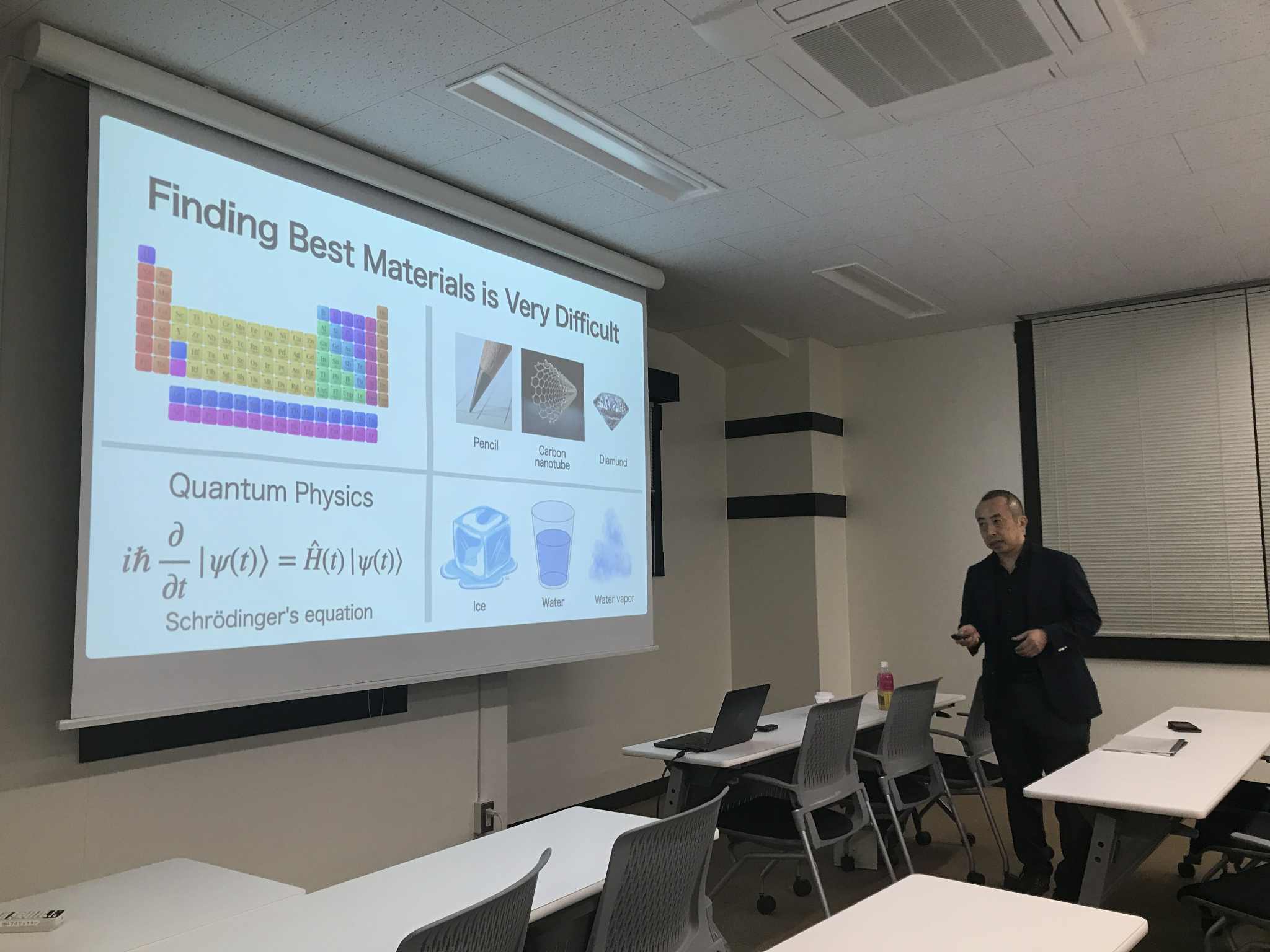
The rapid development of advanced technologies such as AI and robotic arms is spreading to many fields, bringing new perspectives and R&D methods to materials science. I will introduce the development of materials maps that integrate experimental and computational data through machine learning, automated synthesis of nanomaterials such as metal-organic frameworks (MOFs) using robotic arms, electric pipettes, and 3D printers, and autonomous data analysis methods using multi-agent systems with generative AI.

Mapping Thermoelectric Materials Using Machine Learning on Integrated Computational and Experimental Datasets

IMPRES2025 (The 7th International Symposium on Innovative Materials and Processes in Energy Systems)
Keynote Lecture

Abstract

Presented a new mapping method for thermoelectric materials that integrates computational and experimental data using machine learning. This research enables visual representation of structural similarity in materials and rapid extraction of unknown high-performance materials.

Application of a Material Structural Similarity Map to Materials Process Exploration

Japan Society of Applied Physics (JSAP)
Research Presentation

Abstract

Presented a new approach to materials process exploration using material structural similarity maps. This research develops a method to visualize material structural similarity and enable efficient exploration of materials processes.

Local and Global Mapping of Thermoelectric Materials Based on Computational and Experimental Datasets

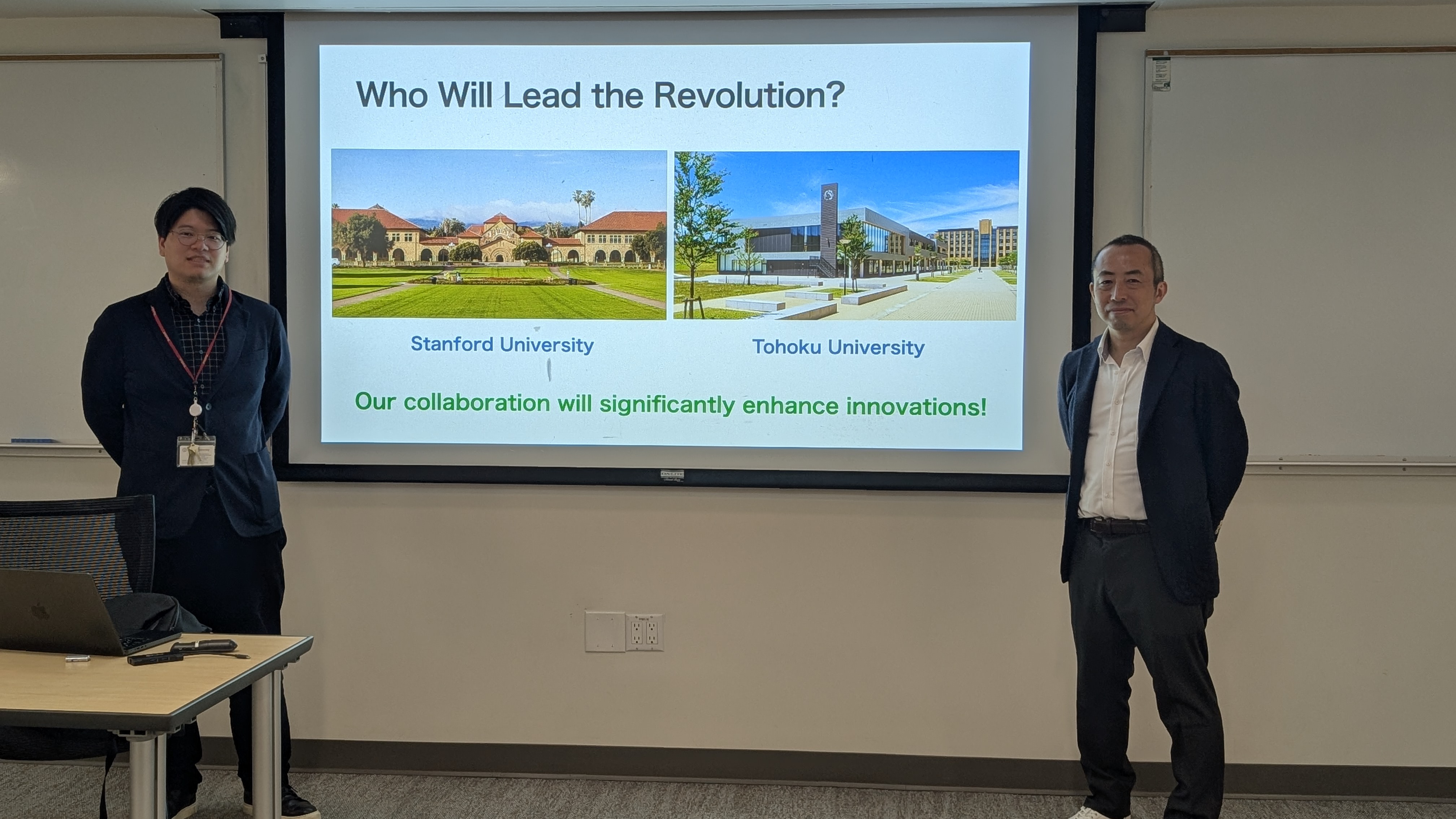
Stanford University - GLAM Special Seminar
Invited Seminar
Stanford University seminar

Abstract

Presented local and global mapping methods for thermoelectric materials based on computational and experimental data. Using machine learning-based materials mapping technology, we introduced a new approach to visualize structure-property correlations of thermoelectric materials and accelerate the search for high-performance materials.

Material Mapping Using Experimental Data and Crystal Graph Neural Networks

APS Global Physics Summit 2025 (March Meeting) - Session: AI for Materials Discovery II (mar-s37)
Contributed Talk

Abstract

Presented a novel materials discovery approach combining experimental thermoelectric data with machine learning. We extracted data from StarryData2 to build predictive models using gradient boosting, and applied crystal graph neural networks (CGNN) to construct material maps that visualize relationships between materials and their thermoelectric performance.

Co-authors: Xue Jia, Hao Li, Takaaki Tomai (Tohoku University)

Related publication: Jia, X., Aziz, A., Hashimoto, Y. et al., "Dealing with the big data challenges in AI for thermoelectric materials," Sci. China Mater. 67, 1173–1182 (2024).